Garage to Glass: How Backyard Brewers Are Shaking Up American Craft Beer
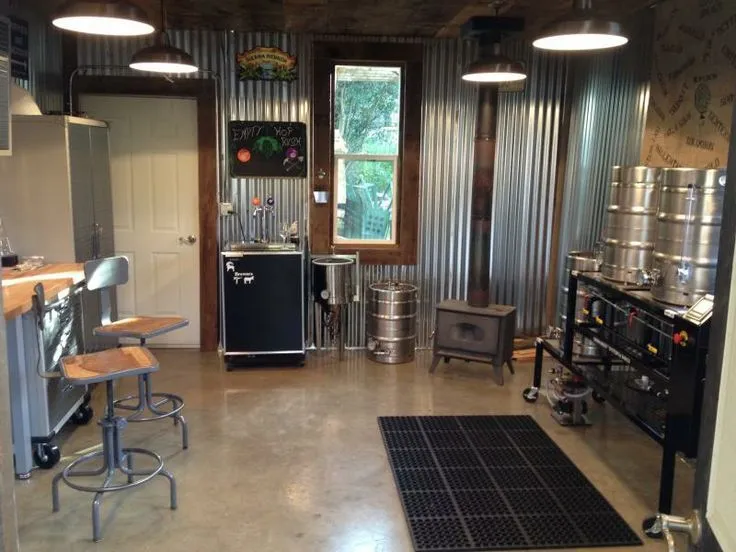
Photo: homebrewer small batch brewing equipment garage workshop, via i.pinimg.com
There's a beat-up chest freezer sitting in a two-car garage in Knoxville, Tennessee. Next to it, a repurposed dairy tank, a hand-labeled fermentation vessel, and a chalkboard covered in grain bill calculations. This is not the romanticized image of American craft brewing — no gleaming stainless steel, no industrial chic taproom, no investor deck. But out of this cluttered, oil-stained space, Darnell Pruitt has been producing some of the most talked-about IPAs in his county for the past three years.
"People ask me when I'm going to get a 'real' brewery," Pruitt says with a laugh. "I tell them I've been selling out every batch I make. Seems pretty real to me."
Pruitt is part of a fast-growing movement reshaping the edges of American craft beer — homebrewers and micro-operators who are making the leap from passion project to legitimate commercial enterprise without following the traditional playbook. No $500,000 buildout. No venture capital. Just skill, hustle, and a willingness to figure it out as they go.
The Cost Problem Nobody Talks About Enough
Here's the uncomfortable math of opening a conventional craft brewery in America today: you're looking at anywhere from $250,000 on the extreme low end to well over a million dollars for a properly equipped production facility with a taproom. Equipment alone — fermenters, bright tanks, a glycol chiller, a canning or bottling line — can swallow six figures before you've brewed a single commercial batch.
For a lot of talented homebrewers with real commercial potential, that capital barrier is simply a wall. Traditional financing is hard to secure for a first-time beverage business with no revenue history. Investors want equity. Bank loans want collateral. The result is that a meaningful chunk of genuinely exceptional brewing talent never makes it out of the garage.
Or at least, that used to be the result.
The Nano and Micro Revolution
Over the last decade, the emergence of nano-brewery and micro-brewery licensing frameworks in many U.S. states has cracked the door open for small-scale operators. While regulations vary significantly by state — and navigating them remains one of the biggest pain points for aspiring commercial brewers — the legal pathway to selling small-batch beer from a non-traditional facility now exists in more places than ever before.
A nano-brewery, loosely defined as a production operation running on a one-to-three barrel system, can be operated out of a space that looks nothing like a conventional brewery. Some states allow production licenses that don't require a full taproom buildout. Others have created cottage brewery or farm brewery designations that open up residential or agricultural properties for small-scale commercial production.
"The regulatory landscape is genuinely improving, but it's still a maze," says craft beverage attorney Sonya Hale, who advises startup breweries across the Southeast. "The biggest mistake I see is people assuming their state's rules are the same as the state they read about online. You have to do the homework for your specific jurisdiction."
Federal TTB licensing is a baseline requirement regardless of state, and the application process — while more streamlined than it was a decade ago — still demands patience, documentation, and often professional guidance. But for those willing to put in the work, the barriers are lower than they've ever been.
Profiles in Garage Grit
Across the country, a loose network of garage-to-commercial success stories is quietly inspiring the next wave of micro-operators.
In Portland, Oregon, a former software engineer named Keiko Tanaka converted her detached garage into a two-barrel production space after spending five years refining her saison and farmhouse ale recipes at home. She now sells through a combination of a small taproom license, local bottle shops, and a weekly pickup model that has built a devoted following. Her total startup investment was under $40,000 — a fraction of what a conventional buildout would have cost.
"I didn't want to spend ten years paying back investors before I could actually experiment with recipes," Tanaka explains. "Staying small kept me free."
In rural Georgia, Marcus and Deb Whitfield run what they describe as a "farm-adjacent" brewery out of a converted equipment barn on their property, leveraging the state's farm winery and brewery designation to sell directly to visitors. Their seasonal small-batch releases sell out within hours of being announced on Instagram.
The Innovation Advantage of Thinking Small
Beyond the economics, there's a creative argument for the garage model that's worth taking seriously. Small-scale operators are unburdened by the production commitments that come with larger facilities. They can experiment freely, pivot quickly, and take risks that a brewery with significant overhead simply cannot afford.
Some of the most interesting beer being brewed in America right now is coming out of these small operations — unusual ingredient combinations, hyper-local grain sourcing, styles that don't fit neatly into market categories. When you're not trying to move ten thousand barrels a year, you can make whatever genuinely excites you.
That spirit of experimentation is, arguably, what American craft beer was built on in the first place. The garage brewers aren't departing from the tradition — they might be the ones keeping it most alive.
What Comes Next
The garage-to-taproom pipeline is only going to grow. Startup costs for small-scale equipment continue to drop as the market for nano-brewery gear matures. Online communities of homebrewers-turned-commercial-operators are sharing regulatory knowledge, equipment sourcing tips, and hard-won lessons with unprecedented openness.
The established craft beer industry would be wise to pay attention. These aren't hobbyists playing at commerce. They're skilled brewers who have chosen a different model — and in more than a few cases, they're making better beer than operations ten times their size.
Darnell Pruitt, back in his Knoxville garage, is already thinking about his next move. A small taproom license. Maybe a second fermenter. Nothing too big, nothing too fast.
"The day I stop being able to taste every single batch before it goes out is the day I've grown too much," he says, pulling the lid off a fermenter and leaning in for a smell. "We're not there yet. Not even close."