Broken Batches and Beautiful Beer: How Brewing Mistakes Became the Craft World's Best Kept Secrets
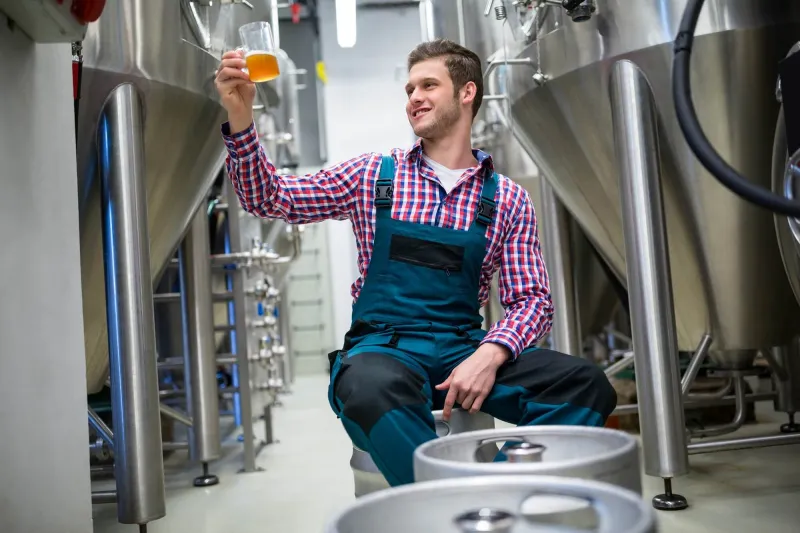
Photo: craft brewer inspecting beer sample in brewery lab with stainless steel tanks, via ezbrew.com.br
There's a story that floats around the craft beer world — the kind that gets better with every retelling over a pint — about a brewer who left a batch fermenting a week too long, panicked when he popped the lid, and then couldn't stop drinking what came out of it. That beer, sour and funky and nothing like what the recipe called for, ended up on the permanent menu. Customers drove hours for it.
That story isn't unique. In fact, it's practically a genre.
Across the American craft brewing landscape, some of the most iconic, award-winning, and flat-out delicious beers exist because something went wrong first. The question is whether a brewer has the guts — and the palate — to recognize a happy accident when it's staring them in the face.
When the Recipe Breaks Down, the Real Brewing Begins
Craft brewing sits at a strange intersection of science and intuition. You've got chemistry, microbiology, temperature controls, and precise measurements on one side. On the other, you've got yeast doing whatever it wants, local water profiles throwing curveballs, and the simple fact that living organisms don't always read the manual.
Most professional brewers will tell you that a perfect batch — one where every variable behaves exactly as expected — is actually the exception, not the rule. The difference between a great brewery and a forgettable one often comes down to what happens in those moments of deviation.
Do you dump the batch? Do you fix it? Or do you taste it, tilt your head, and wonder if you've stumbled onto something nobody's ever tried before?
Brewmasters who've been in the game long enough tend to develop what some call a "failure vocabulary" — an instinct for reading a mistake and categorizing it. Some errors are just errors: a sanitation lapse, a stuck fermentation that produces off-flavors nobody wants. But others carry a kind of strange potential. A brett contamination that gives a pale ale unexpected complexity. An accidental cold crash that produces a clarity nobody expected. A hop addition that went in at the wrong time and somehow created a flavor profile that a hundred intentional experiments couldn't replicate.
The Lucky Town Philosophy: Fortune Favors the Curious
At Lucky Town Brewing, we didn't build our identity around playing it safe. The name says it all — luck is part of the equation. But luck, as any brewer worth their grain bill will tell you, isn't passive. You don't stumble into great beer by accident alone. You stumble into the ingredients of great beer, and then you have to have the skill and the nerve to do something with them.
That's the serendipity formula: preparation meeting an unexpected variable, filtered through a brewer who knows how to listen.
Some of our most talked-about seasonal offerings started life as "problem batches" — runs where something shifted mid-process and the original vision went out the window. Rather than treating those moments as failures, we started treating them as data. What did this batch teach us? What did it produce that we didn't expect? Is there a beer hiding inside this mistake that's actually worth chasing?
More often than you'd think, the answer has been yes.
Real Brewers, Real Accidents
Across the industry, the stories pile up fast.
One Pacific Northwest brewer famously left a batch of imperial stout in a bourbon barrel longer than intended — a logistical oversight, not a creative decision. When they finally cracked it open, the over-oaked, deeply caramelized result was unlike anything on their menu. It sold out in a weekend and generated a waitlist for the next release.
A Midwest farmhouse ale operation accidentally introduced wild yeast during an outdoor spontaneous fermentation experiment that was supposed to be controlled. The resulting beer was unpredictable, tart, and wildly aromatic. They named it after the mistake and built an entire sour program around the strain they'd never intended to cultivate.
Down in Texas, a brewer miscalculated a water chemistry adjustment that pushed the pH of a session IPA somewhere it was never supposed to go. The bitterness softened in a way that made the beer dangerously drinkable. They've been chasing that same "mistake" intentionally ever since — and they'll admit they've never quite nailed it on purpose the way it happened by accident.
Why Playing It Safe Costs You More Than You Think
There's a certain kind of brewery that treats every batch like a liability. Every variable locked down, every deviation corrected, every experiment run through a committee. The beers that come out of those operations are often technically flawless — and completely forgettable.
Craft beer culture has always been built on the opposite impulse. The breweries that earn genuine loyalty, the ones that develop real cult followings, tend to be the ones where you can feel the experimentation in the glass. Where you sense that someone took a risk, or stumbled into something unexpected, and followed it all the way to the tap.
Embracing uncertainty doesn't mean being sloppy. It means building systems that allow for discovery. It means having brewers who are curious enough to taste something unexpected and ask questions rather than reach for the drain valve.
Tasting Your Mistakes Like a Pro
For homebrewers and small-batch experimenters, the lesson here is practical: don't dump too fast. Before you write off a batch that didn't go according to plan, taste it critically. Is the off-flavor a true defect — sulfur, acetaldehyde, a harsh astringency — or is it something stranger and more interesting? Is it tart in a way that might develop? Funky in a way that might work with the right food pairing?
Keep notes on every batch, including the ones that go sideways. Document what went wrong, what the result tasted like, and what you think caused the deviation. Over time, those notes become a library of accidental knowledge that intentional brewing can't fully replace.
The craft beer world's most interesting chapters haven't been written in the planning stages. They've been written in the moments after something unexpected happened, when a brewer took a sip and decided to pay attention.
At Lucky Town, we'll drink to that every time.